

Month: March 2026

Asset Allocation

We live in a complex, integrated and volatile financial world. This growing globalisation makes it imperative to build a portfolio based on the principle of diversification. Asset Allocation is an approach to the process of allocating an investor’s financial resources that consists of spreading those investments across different asset classes. Diversification is therefore the cornerstone of Asset Allocation because, by diversifying the allocation of their assets across multiple asset classes, the investor can reduce the portfolio’s specific risk and improve risk-adjusted returns over time.

According to the Portuguese language dictionary, an “asset” is understood to be a good, value or right that can be converted into money. The vast range of financial assets available can be grouped into 5 major asset classes according to some of their characteristics, in Golden Wealth Management’s view: Liquidity/Money Market, Bonds, Equities, Alternatives and Commodities. Each of these classes is associated with a certain level of risk and expected return, with an increasing relationship between the level of these two variables.

The heterogeneity underlying each asset class means that their behaviour differs across various market environments. Correlation between assets, liquidity conditions and the degree of risk are variable and depend simultaneously on multiple economic factors. An essential condition for good management of the risk/return trade-off associated with the investor’s overall portfolio assumes an efficient use of resources, with a diversified allocation. This is a fundamental assumption for the portfolio’s performance in the medium and long term.

Assuming a moderate profile, traditionally one of the most representative profiles among Portuguese investors, we present the Asset Allocation across the 5 classes.
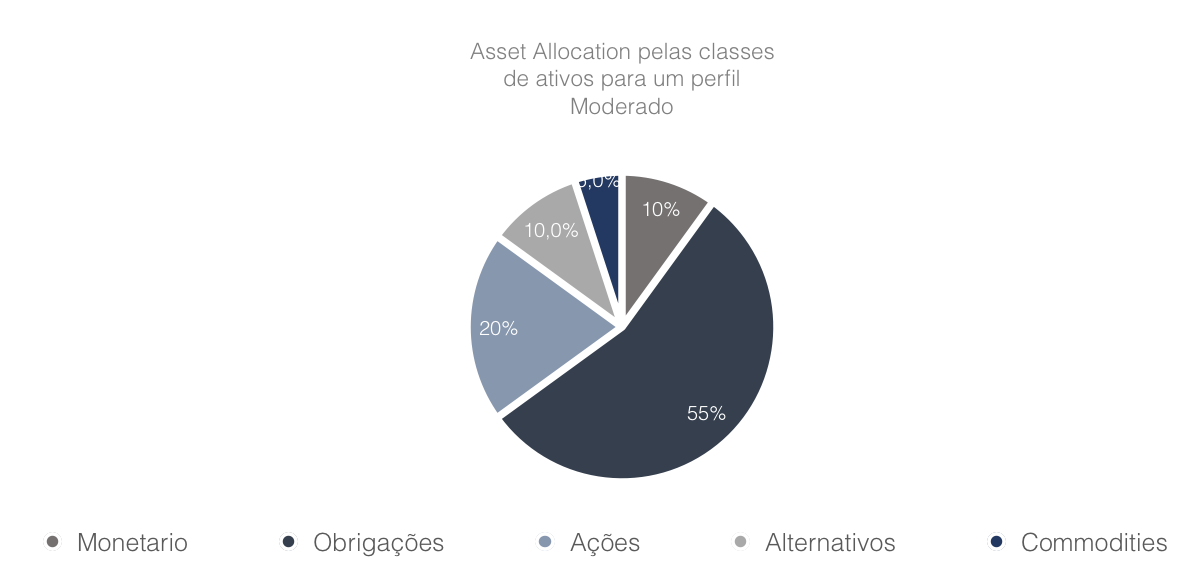
Asset Allocation

It should be noted that the requirement for a stable mix among the various asset classes provides additional protection for the investor against potential shocks and thus contributes to a more balanced portfolio in terms of risk, strategies and management styles.

The superiority of a strategy based on diversification stems from the empirical evidence that, in a properly diversified portfolio, in general, poor performance in a given asset class will be at least partially offset by favourable performance in another asset class (or classes).

This diversification is enhanced through a second level of dispersion and diversification of investments within each of the main asset classes.

Based on several published studies, real historical time series and a proprietary model for estimating expected returns/correlations, at Golden Wealth Management we have built a matrix that allows us to estimate probabilistic scenarios for the evolution of wealth with different confidence levels, without constituting a guarantee of future results.
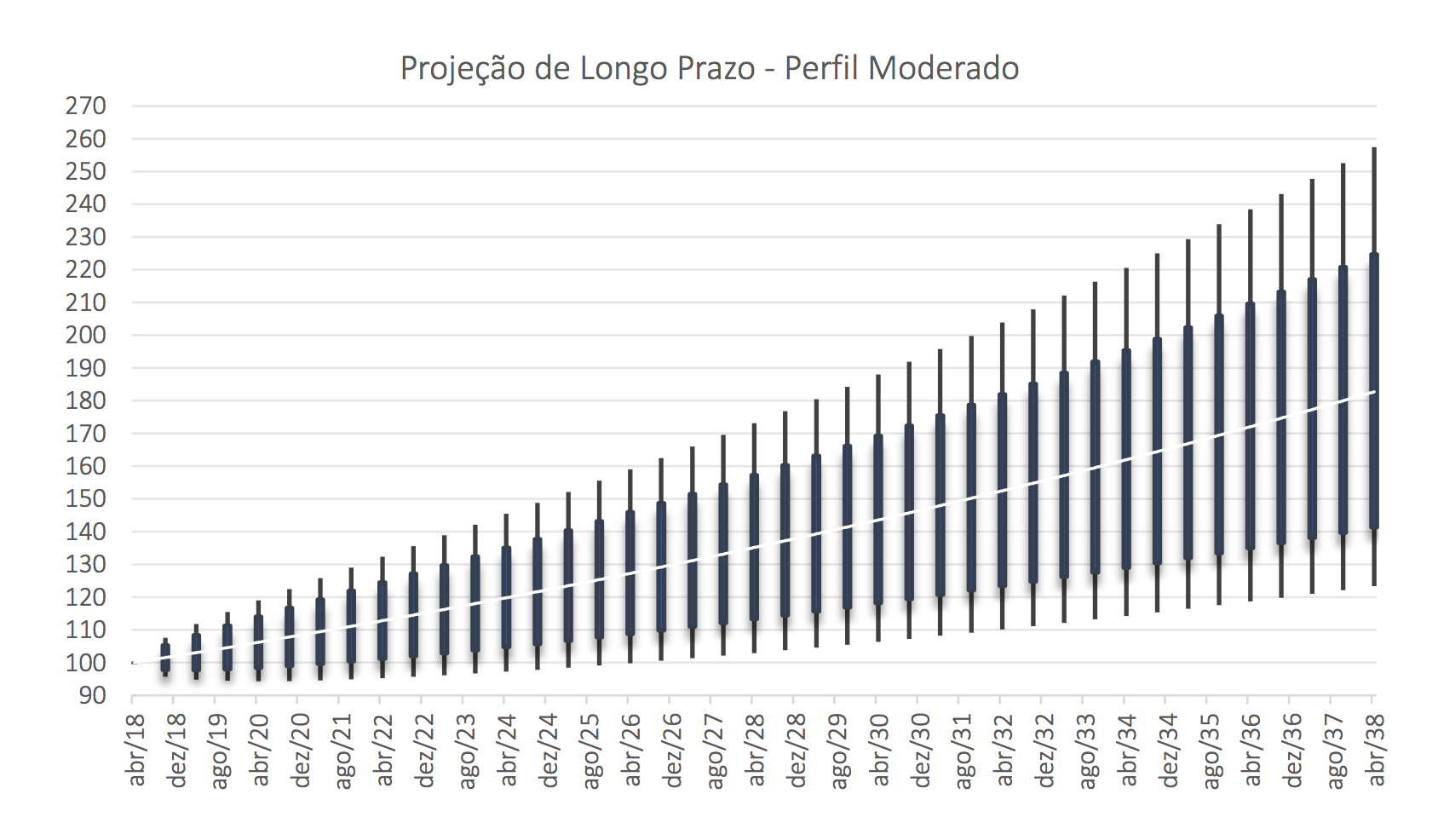
In conclusion, correct Asset Allocation, weighted and optimised according to the investor’s specific situation, is a decisive element for long-term success in their investments.

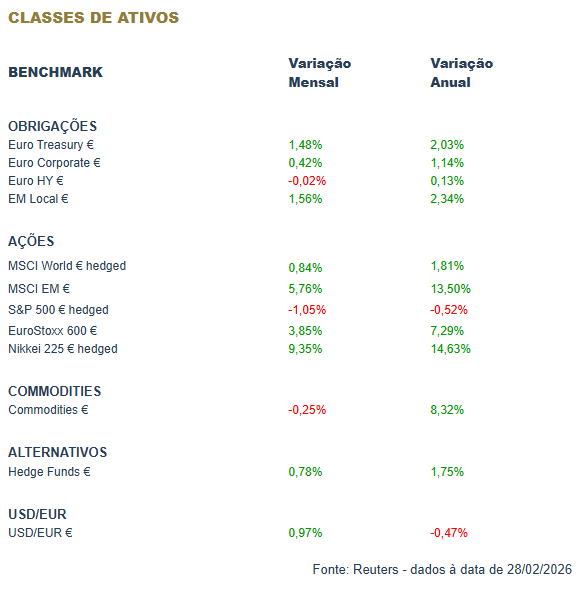
A month of gains, but with asymmetric performance

February was globally positive for financial markets, confirming the strong start to the year, albeit with some asymmetry in returns. Japanese equities stood out with gains, contrasting with a weaker performance from US indices. Japanese stocks benefited from election results, which bolstered the representation of the current Prime Minister’s party and the prospects for more expansionary policies. A gradual rotation from large-cap technology companies to other sectors such as energy, as well as to markets outside the US, is noticeable.

The nomination of Kevin Warsh as the next Fed Chairman was not met with enthusiasm by the markets, but it is still too early to draw conclusions regarding the future path of monetary policy. The minutes from the latest Fed meeting revealed an increasing divide among its members.

On the geopolitical front, signs are mounting that a US intervention in Iran could occur, which provided support for oil and precious metal prices.

The dollar had a month without a clear trend against the euro, but it continues to retreat consistently against the Chinese yuan, hitting nearly three-year lows. Cryptocurrencies intensified their losses, with bitcoin having already surrendered all the gains achieved since the election of Donald Trump.

Asset Classes:

Demand for safe-haven assets increased amid uncertainty influenced by AI-related fears and the US Supreme Court’s decision on Donald Trump’s tariffs. Consequently, February was positive for the bond market, particularly for US public debt. Using the 10-year maturity as a benchmark, US Treasury yields fell by more than 35 bps, while German Bund yields fell by approximately 19 bps. Risk premiums widened slightly but remain near cycle lows, supporting investment grade and high yield corporate debt. The dollar remained relatively stable, supporting emerging market debt, especially that denominated in local currency.

The month was globally positive for most equity markets, but with high geographical dispersion. Emerging markets and Japan stood out in relative terms, benefiting from their own catalysts, including, in the Japanese case, the political validation of a more expansionary economic orientation. Strong sectoral dispersion was also observed. Energy and basic materials remained among the top outperformers, while technology and telecommunications services showed greater relative fragility, reflecting rotation and risk repricing. A central catalyst for this dispersion continues to be the AI/LLM theme, not only as a growth driver but as a competitive shock, with fears of obsolescence and pressure on margins penalizing some business models.

This was a month of marginal loss for the commodities index, negatively affected by the decline in energy prices. Oil was very volatile but closed with little monthly change. Potential US military intervention in Iran continues to dominate attention and create a risk premium in this market. Copper maintained its bullish trend, supported by expectations of higher future consumption despite the evident rise in stocks. The price of natural gas in the US fell by more than a third due to the normalization of temperatures and production near historic highs. Precious metals experienced significant volatility but continued to appreciate in a geopolitical context that favors their purchase. Agricultural products recovered slightly due to higher demand for grains and oilseeds.

The dollar had a trendless month against the euro. The currency has been supported by the possibility of an attack on Iran but hindered by the reallocation of assets outside the US. The pound depreciated to yearly lows against the euro due to prospects of interest rate cuts by the Bank of England and political pressure on the British Prime Minister. The Chinese yuan continues to appreciate against the dollar, reaching highs from April 2023 and its longest weekly winning streak in 13 years. Cryptocurrencies intensified their losses, with bitcoin hitting lows from October 2024. The main crypto-assets have already lost all the valuation gained since the election of Donald Trump.

Conclusion:

February proved to be a globally positive month for the markets, but marked by strong geographical and sectoral dispersion that reinforces the importance of a balanced and diversified approach. International uncertainty—from potential tensions in the Middle East to the lack of definition regarding the path of US monetary policy—continues to be a determining factor for market evolution. Nevertheless, the appreciation of some safe-haven assets, the strength of the yuan, and the relative stability of commodities indicate that the market is seeking a new equilibrium point. In this context, maintaining a long-term view, diversifying intelligently, and closely monitoring macroeconomic developments will be essential elements for seizing opportunities and mitigating risks in the coming months.