

“The Role of Portfolio Rebalancing” – Why rebalancing your portfolio regularly and correctly is key to investment success!
Many investors devote significant effort to deciding which investments are suitable for their needs, spending hours analysing investment ideas, watching specialist programmes in the media, reading a myriad of publications, and speaking with friends or financial professionals. However, they generally overlook one of the most important aspects of managing an investment portfolio: regular rebalancing.
What exactly does this mean, and what are the benefits of portfolio rebalancing?
It is worth noting that one of the key determinants of investment success is being disciplined, patient, and persistent. Historically, we have shown that investors who are patient, over a longer time horizon, achieve very positive returns. However, the path is not linear, and investors will always face, throughout that long journey, more challenging and turbulent periods, filled with uncertainty and volatility. An undisciplined approach, with hasty and emotional decisions, results on average in poorer-quality management decisions, especially during market downturns, and therefore investors are unlikely to benefit from such situations.
Rebalancing helps control portfolio risk and can contribute to improving risk-adjusted returns over time.
Put simply, rebalancing ensures that the portfolio remains within its desired allocation over time. This is necessary because the relative value of the different assets that make up the investment portfolio naturally changes over time and, consequently, the percentage relationship between them also changes as a result. The practice of rebalancing ensures that your portfolio stays on the desired course.
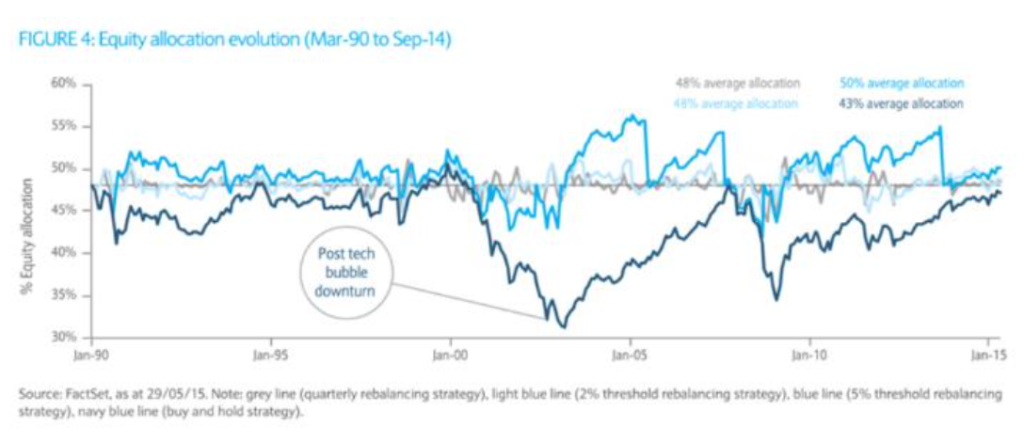
In theory, a successful investor should buy a given financial instrument at a “low” price and sell it at a “high” price (“buy low… sell high!”). This strategy seems simple, but it is extremely difficult to implement. Rebalancing, however, effectively provides a systematic discipline of buying and selling without the need to try to anticipate market movements. The phenomenon of mean reversion suggests that asset prices will, sooner or later, return to their average value. Historically, various assets and asset classes have shown tendencies towards mean reversion over long periods, although this behaviour is not guaranteed.
In practice, rebalancing a portfolio involves selling assets that have outperformed and, for that reason, exceed the initial allocation and, conversely, increasing positions that have underperformed and are therefore below the target percentage. Unconsciously, the investor is implementing a “buy low and sell high” approach and, at the same time, preventing certain positions from increasing the portfolio’s overall risk.
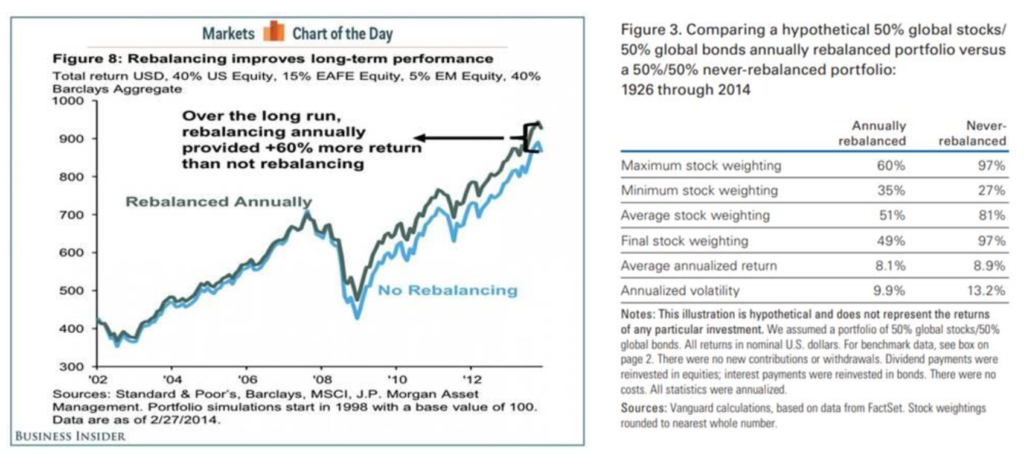
Defining the Asset Allocation will make it possible to determine the frequency and which rebalancing transactions are required, according to the mix defined among the different asset classes and the limits set for each class. Ideally, maximum and minimum limits should be defined for each asset class, as well as a “fluctuation band”. This is because, of course, the magnitude of the variations must be taken into account. Rebalancing too frequently increases costs that, at times, may not be justified by the size of the adjustment. In fact, when it comes to rebalancing, we cannot ignore costs. One solution is to rebalance the portfolio with new contributions (cash, realised gains, reinvested dividends or received interest) and avoid the additional costs of redemption transactions.
For many investors, rebalancing is counterintuitive and emotionally difficult to manage. However, following the tactical allocation defined for your risk profile is essential. In short, why does rebalancing make sense?
- Risk management;
- Counter-cyclical decisions;
- Discipline
At Golden Wealth Management, based on your profile, we design the ideal solution for your portfolio. Golden’s allocation approach focuses on maximising the total return of a diversified portfolio, ensuring transparent risk management that is appropriate to your investment profile. Tactical allocation builds on strategic allocation, but regularly adjusts the portfolio to respond to changing market conditions, forecasts, and convictions.