

Monetary policy and interest-rate dynamics were in the spotlight during September and significantly influenced financial markets.
Several central banks raised interest rates, most notably, of course, the European Central Bank and the US Federal Reserve. In both cases, benchmark rates rose by 25 basis points, with a strong likelihood that the tightening cycle will continue.
Sovereign debt came under pressure, reflected in historically high interest rates. US 10-year yields reached 2007 highs at 5.30%, and Germany reached 2008 highs at 3.65%. The rise in yields in France has been particularly notable, in this case to 4.86%, and above all the widening of the spread versus Germany.
In equities, despite a slight correction in September, the quarter was again positive for the US. The S&P 500 posted a second consecutive quarter of gains, with September’s decline limited compared with the cumulative appreciation throughout 2026.
Rising energy prices continued to affect the rest of the markets. The war in the Middle East and restrictions on fuel supply are fuelling fears of inflation and higher interest rates for longer.
The dollar strengthened broadly, partly due to expectations of higher interest rates. EUR/USD fell to $1.1310, a 16-month low, amid concerns about the French public debt situation.
Breakdown by asset class:
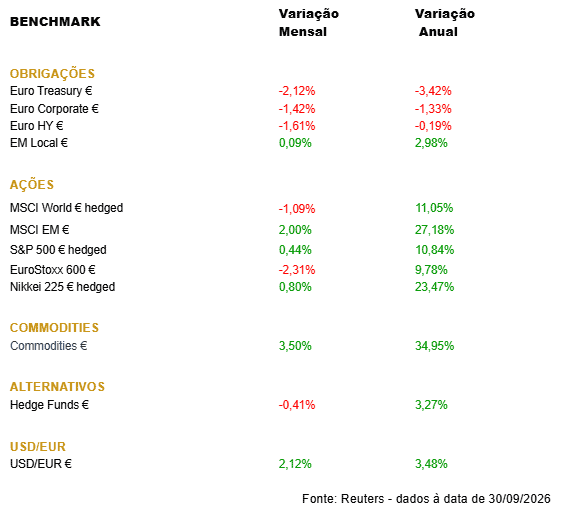
Bonds:
- September was again a negative month for the bond market, as monetary authorities showed growing concern about the potential spillover of energy price pressures to wages and the services sector.
- Fears that these shocks will persist ultimately forced central banks to prioritise inflation control, justifying further interest-rate hikes by the ECB and the start of a normalisation cycle by the Fed.
- This adjustment translated into selling pressure across different maturities along yield curves, accompanied by a widening of risk premia in the corporate credit segment, in a broadly negative move across most bond markets.
- Despite this adverse backdrop, emerging-market debt showed remarkable resilience, particularly local-currency debt, even in a context of US dollar strength.
Equity Market:
- Equities edged lower globally, with the MSCI World index down just over 1%.
- Europe had a more difficult month, with the STOXX Europe 600 down 2.3%, recording its first monthly decline in six months. Rising long-term interest rates and inflation concerns weighed on prices.
- The US showed greater resilience, but with notable divergence. Technology/AI continued to stand out. The Nasdaq 100 gained approximately 3% over the month, contrasting with the slight decline in the S&P 500. Investment in AI infrastructure continued to support growth and earnings expectations.
- Despite the monthly correction, the quarter ended positive in the US: the S&P 500 posted a second consecutive quarter of gains, showing that September’s decline was relatively limited compared with the cumulative appreciation throughout 2026.
Commodities:
- The commodities index rose 3.5%, largely supported by gains in oil and natural gas.
- Oil again closed the month with a sharp rise, especially in benchmarks outside the US, amid the lack of resolution in the Strait of Hormuz and Saudi exports to the Red Sea temporarily halted.
- Gold fell by more than 6%, weighed down by higher benchmark rates, surging bond yields, and a strong dollar.
- Industrial metals saw sharp swings, but little monthly change.
- Agricultural commodities posted losses close to 5%, due to an overall situation in the most relevant crops being in better condition than previously estimated.
- Natural gas prices remained elevated in Europe due to low inventories and the absence of exports from Qatar. In the US, gains were modest, associated with some decline in production.
FX Market:
- Greater clarity on monetary policy from the Fed allowed the dollar to strengthen broadly in September. The differential in nominal and real interest rates between the dollar and other currencies favoured the US currency.
- After a very positive August, EUR/USD fell to 16-month lows, reaching $1.1310. Fears of a new debt crisis have been rising, with developments in France on investors’ minds.
- The pound had a volatile month against the euro, but closed at one-month lows, below £0.8540. Prime Minister Andy Burnham opened the door to the UK rejoining the European Union.
- It was another positive month for cryptoassets. Bitcoin regained the $87,000 level, even in a challenging context of rising interest rates and the rejection of the advancement of the United States cryptoasset regulation bill (Clarity Act).
September reinforced the importance of monetary policy in the evolution of financial markets. In a context of high interest rates and greater economic uncertainty, investors’ attention will remain focused on central bank decisions and the outlook for inflation.