

Tag: FED

A month of gains, but with asymmetric performance

February was globally positive for financial markets, confirming the strong start to the year, albeit with some asymmetry in returns. Japanese equities stood out with gains, contrasting with a weaker performance from US indices. Japanese stocks benefited from election results, which bolstered the representation of the current Prime Minister’s party and the prospects for more expansionary policies. A gradual rotation from large-cap technology companies to other sectors such as energy, as well as to markets outside the US, is noticeable.

The nomination of Kevin Warsh as the next Fed Chairman was not met with enthusiasm by the markets, but it is still too early to draw conclusions regarding the future path of monetary policy. The minutes from the latest Fed meeting revealed an increasing divide among its members.

On the geopolitical front, signs are mounting that a US intervention in Iran could occur, which provided support for oil and precious metal prices.

The dollar had a month without a clear trend against the euro, but it continues to retreat consistently against the Chinese yuan, hitting nearly three-year lows. Cryptocurrencies intensified their losses, with bitcoin having already surrendered all the gains achieved since the election of Donald Trump.

Asset Classes:
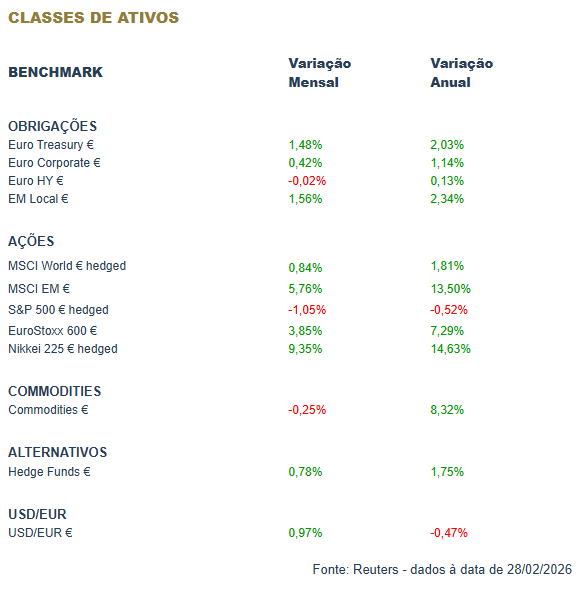
Demand for safe-haven assets increased amid uncertainty influenced by AI-related fears and the US Supreme Court’s decision on Donald Trump’s tariffs. Consequently, February was positive for the bond market, particularly for US public debt. Using the 10-year maturity as a benchmark, US Treasury yields fell by more than 35 bps, while German Bund yields fell by approximately 19 bps. Risk premiums widened slightly but remain near cycle lows, supporting investment grade and high yield corporate debt. The dollar remained relatively stable, supporting emerging market debt, especially that denominated in local currency.

The month was globally positive for most equity markets, but with high geographical dispersion. Emerging markets and Japan stood out in relative terms, benefiting from their own catalysts, including, in the Japanese case, the political validation of a more expansionary economic orientation. Strong sectoral dispersion was also observed. Energy and basic materials remained among the top outperformers, while technology and telecommunications services showed greater relative fragility, reflecting rotation and risk repricing. A central catalyst for this dispersion continues to be the AI/LLM theme, not only as a growth driver but as a competitive shock, with fears of obsolescence and pressure on margins penalizing some business models.

This was a month of marginal loss for the commodities index, negatively affected by the decline in energy prices. Oil was very volatile but closed with little monthly change. Potential US military intervention in Iran continues to dominate attention and create a risk premium in this market. Copper maintained its bullish trend, supported by expectations of higher future consumption despite the evident rise in stocks. The price of natural gas in the US fell by more than a third due to the normalization of temperatures and production near historic highs. Precious metals experienced significant volatility but continued to appreciate in a geopolitical context that favors their purchase. Agricultural products recovered slightly due to higher demand for grains and oilseeds.

The dollar had a trendless month against the euro. The currency has been supported by the possibility of an attack on Iran but hindered by the reallocation of assets outside the US. The pound depreciated to yearly lows against the euro due to prospects of interest rate cuts by the Bank of England and political pressure on the British Prime Minister. The Chinese yuan continues to appreciate against the dollar, reaching highs from April 2023 and its longest weekly winning streak in 13 years. Cryptocurrencies intensified their losses, with bitcoin hitting lows from October 2024. The main crypto-assets have already lost all the valuation gained since the election of Donald Trump.

Conclusion:

February proved to be a globally positive month for the markets, but marked by strong geographical and sectoral dispersion that reinforces the importance of a balanced and diversified approach. International uncertainty—from potential tensions in the Middle East to the lack of definition regarding the path of US monetary policy—continues to be a determining factor for market evolution. Nevertheless, the appreciation of some safe-haven assets, the strength of the yuan, and the relative stability of commodities indicate that the market is seeking a new equilibrium point. In this context, maintaining a long-term view, diversifying intelligently, and closely monitoring macroeconomic developments will be essential elements for seizing opportunities and mitigating risks in the coming months.

January Under Strong Geopolitical Pressure

There was no shortage of volatility and turmoil at the start of the year, both in financial markets and geopolitically. Despite a correction right at the end of the month, January was positive across the various asset classes. Overall, the market proved resilient to the month’s events.

The USA carried out a military intervention in Venezuela with the aim of detaining Nicolas Maduro and gaining greater control over the country, particularly its oil industry. Donald Trump’s interest in Greenland caused additional friction between the USA and Europe, and the threat of a US attack on Iran persisted. The Davos summit was particularly well attended this year, making clear the discomfort among the various global blocs, which are trying to diversify their exposure to the USA. The European Union signed trade agreements with India and Mercosur.

The US Federal Reserve kept its benchmark interest rate unchanged for the first time since July and indicated that conditions are not in place for rate cuts in the coming months. Donald Trump announced Kevin Warsh as the next leader of the Fed. This appointment may ease some concerns about pressure from the White House on the Fed to cut rates.

Precious metals once again stood out for both gains and volatility. Gold and silver repeatedly set new all-time highs, although they corrected at the end of the month. The dollar had a negative month, with EUR/USD reaching $1.2078—its highest level since June 2021. Cryptoassets posted negative performance, failing to keep pace with moves in precious metals.

Asset Classes:

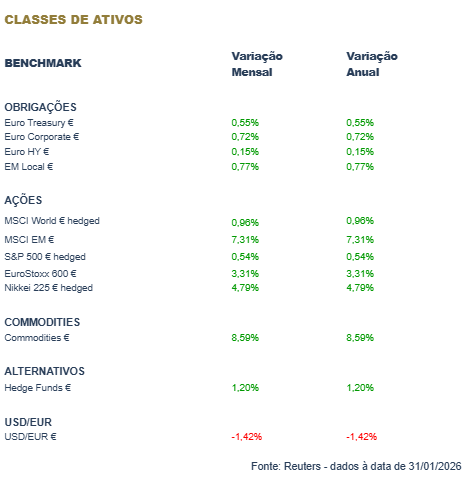
The year began packed with geopolitical events, with Donald Trump playing a central role in their developments. Volatility has remained relatively contained, though with some intraday episodes. Despite this backdrop, debt markets have remained orderly, and even growing concerns around the Fed’s independence and the appointment of its new chair (Kevin Warsh) were not enough to interrupt monthly gains.

Corporate risk premia remained close to the lows of the current cycle, also validating a constructive investor sentiment. The weakening of the US dollar against major currencies ended up weighing on emerging-market debt, especially that denominated in local currency.

In equity markets, January stood out for the intensity of geopolitical risk, with potentially material effects in the short, medium and long term, with Donald Trump as the main catalyst. Despite the noise, volatility in US equity markets remained contained, but with a clear rotation from large to small caps and from technology to energy, industrials and materials. Geographically, the turbulence favoured a strong rotation into emerging markets, with Brazil standing out. Thematically, miners linked to precious metals and uranium showed extraordinary strength, with increasingly parabolic moves.

For the commodities index, it was a month of sharp gains, close to 9%, benefiting from strong investor interest in some of the main categories. Oil rose around 13%, supported by production issues in Kazakhstan and the potential for a US attack on Iran. Copper gained a further 5% on strong investor interest, despite evidence of a broad rise in inventories. US natural gas rose around 16% in a month of extreme price volatility, affected by days of exceptionally low temperatures. Precious metals continue to surge in this context of geopolitical change. Gold rose 11% and silver 18%. Agricultural commodities saw no noteworthy changes, remaining at relatively low prices, with ample global supply across most major products.

In the foreign exchange market, the dollar ended the month lower, posting its weakest levels against the euro since June 2021. EUR/USD traded as high as $1.2078, correcting in the last two sessions of January. The dollar fell due to greater market distrust regarding the USA’s geopolitical stance, but also following rumours that a joint FX intervention between the Fed and the Bank of Japan was being prepared to defend the yen. The Swiss franc ended up being the main beneficiary as a safe-haven asset in times of geopolitical uncertainty. Against the euro, the Swiss franc reached its highest level since the January 2015 “flash crash”. Cryptocurrencies continue not to attract market interest at this stage. Bitcoin ended the month at lows of more than two months, and the same happened with ether.

Conclusion:

In a start to the year marked by intense geopolitical developments and rapid market moves, January showed that, despite uncertainty, investors continue to find resilience across several asset classes. Diversification once again proved its value in a month in which precious metals, energy and emerging markets led gains, while global debt maintained a balanced performance even amid doubts about US monetary policy. This start to the year therefore reinforces the importance of an allocation tailored to the risk profile, capable of navigating periods of volatility without losing sight of the investment horizon.