

Month: February 2026

Outlook 2026: Navigating a Cycle of Change with Strategy

The year 2026 is shaping up as a period of continuity, but also of new structural challenges. After a 2025 shaped by trade instability and exceptional valuations in precious metals—with gold and silver achieving historic returns—Golden Wealth Management enters the new year with a clear view: grounded optimism, guided by prudence.

A Year of Historic Milestones and Consistent Results

The year 2025 will be etched in our history as a truly special period. As we celebrated Golden’s 25th anniversary, we reached the milestone of €2 billion in assets under advisory—a figure that, above all, reflects the strength of the trust our clients place in our work. This was also a year of historic returns across all Golden profiles.

More than isolated figures, these results celebrate the consistency of our method and process, evident in the cumulative returns since 2015, which have reached 102.36% in the Equity Profile. To reinforce this commitment to transparency, we launched the MyGolden app, a differentiating tool that enables consolidated monitoring of all wealth information.

Opportunities on the Horizon in 2026

For 2026, we anticipate that fiscal policies, particularly in the United States, will continue to support global economic growth. This factor, combined with a more accommodative monetary policy from central banks, creates a favourable environment for equities.

However, our investment team remains attentive to elevated valuations in certain markets. Therefore, this year’s strategy focuses on rigorous selectivity, whether across geographies, sectors, or real assets.

Risk Management: The Value of Agility

The year 2026 will not be free of volatility. We identify three risk pillars that require constant monitoring:

  • Geopolitics: Trump’s leadership in the US, with tariff policies and unpredictable decisions, could amplify instability and alter trade flows.
  • Generative Artificial Intelligence: vigilance against excessive enthusiasm (potential bubbles) and the high concentration of returns in a few names.
  • Bonds and Inflation: risk of yields rising due to worsening fiscal imbalances in the US.

Conclusion:

At Golden Wealth Management, we understand that 2026 requires more than a static reading of the markets; it requires the ability to respond immediately to volatility. Our philosophy for this year focuses on agility and risk mitigation, ensuring that each portfolio is adjusted dynamically to protect capital without foregoing the windows of opportunity this new cycle offers.

January Under Strong Geopolitical Pressure

There was no shortage of volatility and turmoil at the start of the year, both in financial markets and geopolitically. Despite a correction right at the end of the month, January was positive across the various asset classes. Overall, the market proved resilient to the month’s events.

The USA carried out a military intervention in Venezuela with the aim of detaining Nicolas Maduro and gaining greater control over the country, particularly its oil industry. Donald Trump’s interest in Greenland caused additional friction between the USA and Europe, and the threat of a US attack on Iran persisted. The Davos summit was particularly well attended this year, making clear the discomfort among the various global blocs, which are trying to diversify their exposure to the USA. The European Union signed trade agreements with India and Mercosur.

The US Federal Reserve kept its benchmark interest rate unchanged for the first time since July and indicated that conditions are not in place for rate cuts in the coming months. Donald Trump announced Kevin Warsh as the next leader of the Fed. This appointment may ease some concerns about pressure from the White House on the Fed to cut rates.

Precious metals once again stood out for both gains and volatility. Gold and silver repeatedly set new all-time highs, although they corrected at the end of the month. The dollar had a negative month, with EUR/USD reaching $1.2078—its highest level since June 2021. Cryptoassets posted negative performance, failing to keep pace with moves in precious metals.

Asset Classes:

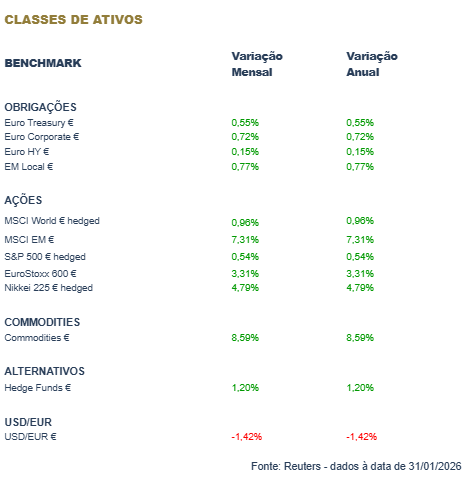
The year began packed with geopolitical events, with Donald Trump playing a central role in their developments. Volatility has remained relatively contained, though with some intraday episodes. Despite this backdrop, debt markets have remained orderly, and even growing concerns around the Fed’s independence and the appointment of its new chair (Kevin Warsh) were not enough to interrupt monthly gains.

Corporate risk premia remained close to the lows of the current cycle, also validating a constructive investor sentiment. The weakening of the US dollar against major currencies ended up weighing on emerging-market debt, especially that denominated in local currency.

In equity markets, January stood out for the intensity of geopolitical risk, with potentially material effects in the short, medium and long term, with Donald Trump as the main catalyst. Despite the noise, volatility in US equity markets remained contained, but with a clear rotation from large to small caps and from technology to energy, industrials and materials. Geographically, the turbulence favoured a strong rotation into emerging markets, with Brazil standing out. Thematically, miners linked to precious metals and uranium showed extraordinary strength, with increasingly parabolic moves.

For the commodities index, it was a month of sharp gains, close to 9%, benefiting from strong investor interest in some of the main categories. Oil rose around 13%, supported by production issues in Kazakhstan and the potential for a US attack on Iran. Copper gained a further 5% on strong investor interest, despite evidence of a broad rise in inventories. US natural gas rose around 16% in a month of extreme price volatility, affected by days of exceptionally low temperatures. Precious metals continue to surge in this context of geopolitical change. Gold rose 11% and silver 18%. Agricultural commodities saw no noteworthy changes, remaining at relatively low prices, with ample global supply across most major products.

In the foreign exchange market, the dollar ended the month lower, posting its weakest levels against the euro since June 2021. EUR/USD traded as high as $1.2078, correcting in the last two sessions of January. The dollar fell due to greater market distrust regarding the USA’s geopolitical stance, but also following rumours that a joint FX intervention between the Fed and the Bank of Japan was being prepared to defend the yen. The Swiss franc ended up being the main beneficiary as a safe-haven asset in times of geopolitical uncertainty. Against the euro, the Swiss franc reached its highest level since the January 2015 “flash crash”. Cryptocurrencies continue not to attract market interest at this stage. Bitcoin ended the month at lows of more than two months, and the same happened with ether.

Conclusion:

In a start to the year marked by intense geopolitical developments and rapid market moves, January showed that, despite uncertainty, investors continue to find resilience across several asset classes. Diversification once again proved its value in a month in which precious metals, energy and emerging markets led gains, while global debt maintained a balanced performance even amid doubts about US monetary policy. This start to the year therefore reinforces the importance of an allocation tailored to the risk profile, capable of navigating periods of volatility without losing sight of the investment horizon.