
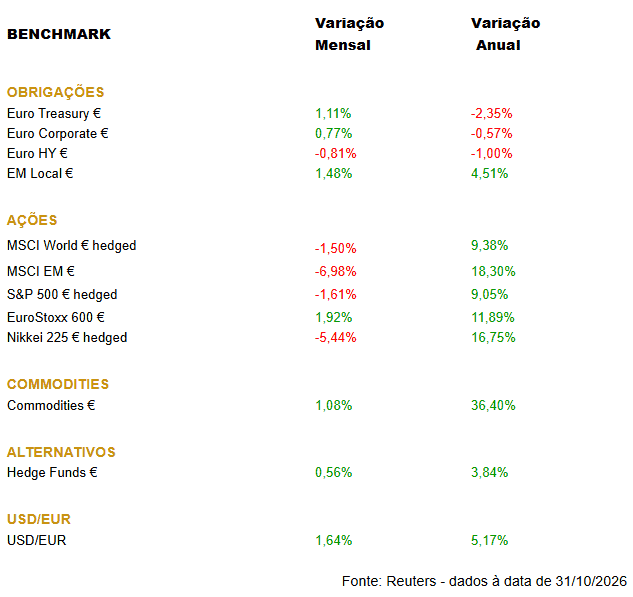
Asset classes delivered markedly divergent performances in October. The main highlight was the relief in the bond markets, particularly in sovereign debt. France was the exception: 10-year yields closed the month near 5%, while the spread versus Germany widened to 165 basis points.
The Federal Reserve and the European Central Bank kept their benchmark interest rates unchanged, with the market expecting a rate hike in December in both cases. Christine Lagarde announced she will step down as ECB President on 7 February 2027, following that month’s monetary policy meeting.
Equities closed the month mostly lower, with a notable pullback in the emerging markets segment, impacted by the outcome of the presidential election in Brazil, which triggered sharp declines in the real and in Brazilian stocks. Return divergence was also evident in commodities, with energy (particularly oil and European natural gas) gaining ground, while precious metals declined.
The dollar strengthened again, with Eur/Usd hitting lows not seen since May 2025, at $1.1103. Cryptocurrencies pulled back, especially toward the end of the month. The cyberattack on Binance — the world’s largest crypto exchange — which reportedly suffered losses of over $6 billion, dented market confidence.
Bonds
- After the sharp corrections seen in September, October was marked by the return of investor interest, who found in higher-quality sovereign debt a refuge amid growing economic uncertainty.
- Demand for more defensive assets favoured investment-grade credit, while high yield debt posted losses, reflecting investors’ worsening risk perception.
- Emerging market debt in local currency had another positive month, despite corrections in the last week of the month stemming from Lula da Silva’s re-election in Brazil and doubts over the country’s future economic policy direction.
Equity Markets
- Europe had a positive month, with the STOXX Europe 600 rising close to 2%, recovering part of September’s losses. Switzerland stood out (SMI gaining nearly 7%), while Portugal’s PSI fell more than 4%.
- Equities declined globally, with the index MSCI World falling around 1.5%, amid strong regional and sectoral divergence. Losses in emerging markets stood out, driven by the impact of declines in Brazil.
- In the US, the S&P 500 fell close to 1.5%, while the Technology/AI sector reversed September’s role, with the Nasdaq 100 dropping more than 6%. Third-quarter earnings season reignited concerns over returns on AI infrastructure investment, with Meta falling around 9% after revising its capex guidance.
- Despite the Technology correction, the US still holds gains for the year: the S&P 500 up about 11% and the Nasdaq 100 up roughly 12% since the start of 2026.
Commodities
- The commodities index posted a slight gain, largely supported by gains in oil.
- Oil had another month of gains above 10%. Despite evidence of higher exports from the Middle East, the geopolitical situation in the region remains far from stable, with ships regularly coming under attack.
- Gold posted a loss of close to 6%, continuing to be pressured by high inflation, elevated bond yields, and a strong dollar.
- Some industrial metals suffered significant losses, but copper fell only slightly given the concentration of refined metal in the US.
- Agricultural commodities posted losses of around 4%, with confirmation of very high soybean and corn production in the US and the fact that no significant losses from the El Niño phenomenon have emerged so far.
- Natural gas hit four-year highs in Europe, but saw little movement in the US. Export disruptions from Qatar continue to put upward pressure on prices outside the US, where inventories remain at comfortable levels.
Currency Markets
- The dollar had another positive month against the euro, with Eur/Usd falling to levels not seen since May 2025.
- Prospects of rate hikes by the Fed and, above all, concerns over France’s fiscal position drove the euro’s depreciation.
- The pound had a positive month against the euro, benefiting from concerns related to France and the market’s favourable reception of the UK’s 2027 Budget.
- The Brazilian real reacted very negatively to Lula da Silva’s re-election. The real depreciated around 4.5% in October, with Usd/Brl reaching as high as R$5.60, a level not seen since December of last year.
- The Chinese yuan remains on an uptrend and once again set four-year highs against the dollar.
- Cryptocurrencies were in negative territory, a decline that accelerated after the cyberattack on Binance, which reportedly lost more than $6 billion.
Conclusion
The performance of financial markets in October reinforced the importance of a diversified approach to investing. Between the recovery in bonds, equity volatility, and divergent movements in commodities and currencies, risk management remained a key factor for investors.