

Category: Investment Principles

Asset Allocation

We live in a complex, integrated and volatile financial world. This growing globalisation makes it imperative to build a portfolio based on the principle of diversification. Asset Allocation is an approach to the process of allocating an investor’s financial resources that consists of spreading those investments across different asset classes. Diversification is therefore the cornerstone of Asset Allocation because, by diversifying the allocation of their assets across multiple asset classes, the investor can reduce the portfolio’s specific risk and improve risk-adjusted returns over time.

According to the Portuguese language dictionary, an “asset” is understood to be a good, value or right that can be converted into money. The vast range of financial assets available can be grouped into 5 major asset classes according to some of their characteristics, in Golden Wealth Management’s view: Liquidity/Money Market, Bonds, Equities, Alternatives and Commodities. Each of these classes is associated with a certain level of risk and expected return, with an increasing relationship between the level of these two variables.

The heterogeneity underlying each asset class means that their behaviour differs across various market environments. Correlation between assets, liquidity conditions and the degree of risk are variable and depend simultaneously on multiple economic factors. An essential condition for good management of the risk/return trade-off associated with the investor’s overall portfolio assumes an efficient use of resources, with a diversified allocation. This is a fundamental assumption for the portfolio’s performance in the medium and long term.

Assuming a moderate profile, traditionally one of the most representative profiles among Portuguese investors, we present the Asset Allocation across the 5 classes.
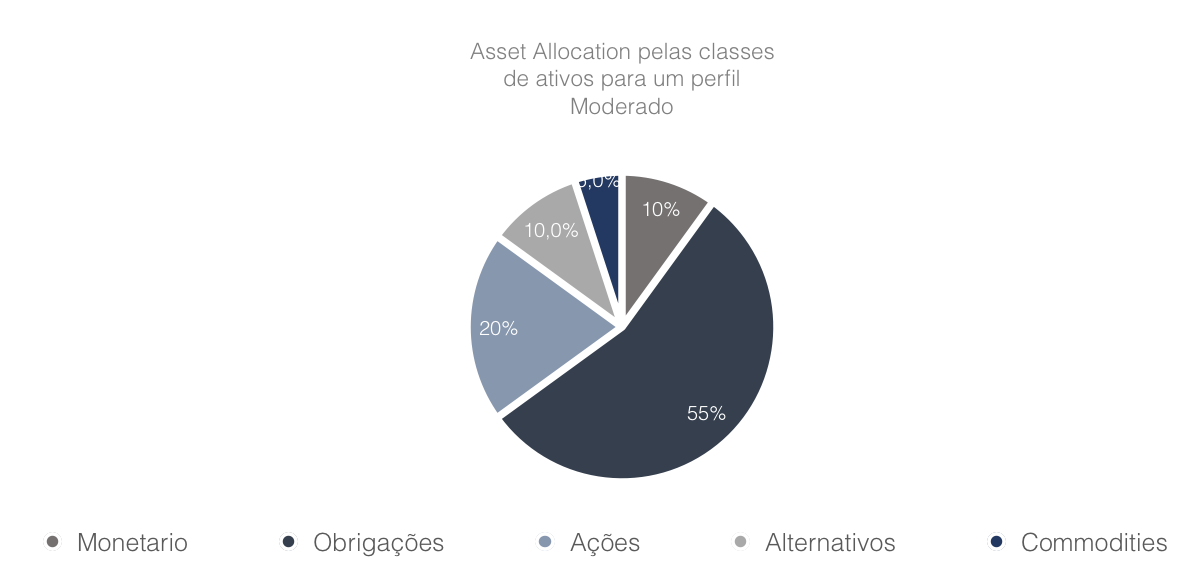
Asset Allocation

It should be noted that the requirement for a stable mix among the various asset classes provides additional protection for the investor against potential shocks and thus contributes to a more balanced portfolio in terms of risk, strategies and management styles.

The superiority of a strategy based on diversification stems from the empirical evidence that, in a properly diversified portfolio, in general, poor performance in a given asset class will be at least partially offset by favourable performance in another asset class (or classes).

This diversification is enhanced through a second level of dispersion and diversification of investments within each of the main asset classes.

Based on several published studies, real historical time series and a proprietary model for estimating expected returns/correlations, at Golden Wealth Management we have built a matrix that allows us to estimate probabilistic scenarios for the evolution of wealth with different confidence levels, without constituting a guarantee of future results.
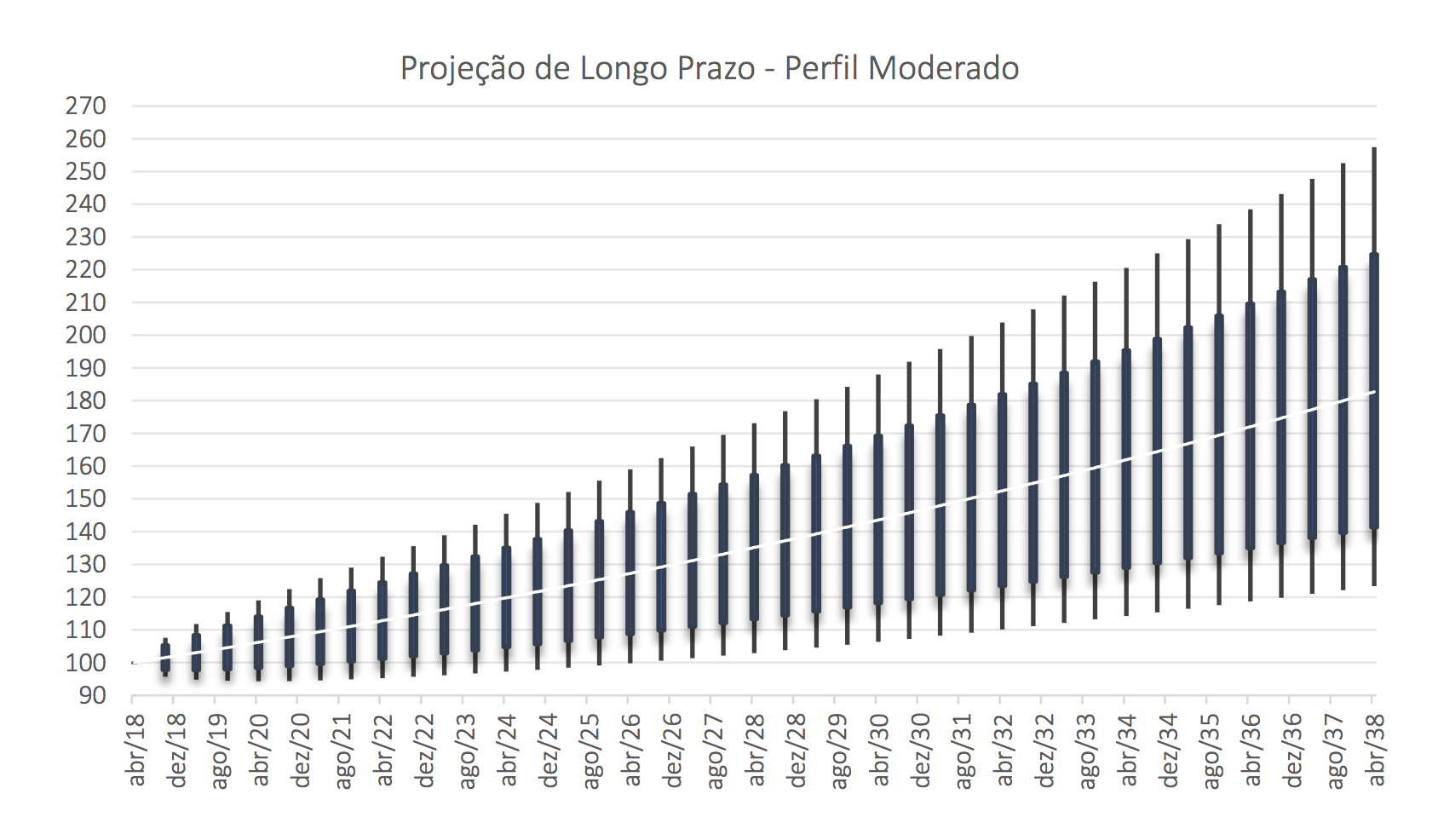
In conclusion, correct Asset Allocation, weighted and optimised according to the investor’s specific situation, is a decisive element for long-term success in their investments.

Real Estate Investment: SIGIs

SIGI VS. REIF – THE MISSING CATALYST?

Real estate investment is generally regarded as an appropriate way to diversify wealth compared with investing in financial markets. More specifically, the typical Portuguese investor has a considerable share of their wealth allocated to real estate assets.

This inclination—or even preference—for this asset class is not accidental. It is explained by the aura of security associated with it, as well as by long-standing factors (multiple generations accumulating wealth and, consequently, passing it on through inheritances), given that the widespread presence of financial markets in Portugal is relatively recent.

When referring to the aura of security that real estate enjoys, this is due to the fact that, over a long period, these were assets with a trend of steady appreciation (hence the famous phrase “you never lose money on property”), an aura that was shaken by the 2007–2008 subprime crisis.

Some of the main characteristics of (financial) assets traded on regulated markets are standardisation, liquidity and ease of trading. In general, these securities require little in terms of minimum investment, are easily comparable, trade almost continuously, and the buying/selling process is very straightforward.

By contrast, direct investment in property is extremely costly, highly demanding in terms of capital allocation, illiquid and non-standardised.

Until now, the alternative to direct real estate investment was Real Estate Investment Funds (REIF), which, due to their characteristics, have been losing prominence over time.

In fact, REIFs were intended to make property investment more flexible; however, their structure ultimately fails to achieve that purpose, as these vehicles have traditionally had a high cost structure, limited liquidity and substantially penalising redemption conditions—limitations that became even more evident during the 2007–2008 subprime crisis.

In addition to an annual management fee, they generally charge subscription and/or redemption fees that can reach 5%.

In terms of liquidity, in addition to having less stringent quotation publication requirements than securities investment funds, in some cases on a monthly basis. Also regarding liquidity, between the redemption request and its financial settlement, in some situations there may be a difference of 6 months!

The offer available to investors in Portugal, with the limitations mentioned, combined with the attractiveness the real estate market has shown in the recent past, led to the promotion of a framework that would truly enable agile, simplified and low-cost investment.

The framework that governs the creation and operation of Real Estate Investment and Management Companies (SIGIs) led to the creation of vehicles that enable investment in the real estate market in a simplified, less costly and more flexible way. To learn more about the SIGI framework, click here.

Contact us to learn more about this new paradigm, which may bring benefits to the market as a whole, as it may prove to be a very advantageous investment alternative for investors, while also enabling greater dynamism in the real estate market by opening it even further to capital markets.