

March turned out to be a difficult month for most financial assets, reflecting the military intervention by the United States and Israel in Iran, which escalated to other parts of the Middle East, blocked the Strait of Hormuz, and triggered a sharp rise in oil prices and other energy goods.
Losses were particularly significant in equity markets, driven by rising uncertainty and risk aversion amid fears of an inflationary surge accompanied by economic slowdown (stagflation) that could force central banks to raise benchmark interest rates. The commodities index was the notable exception, climbing more than 15%, driven by higher oil and refined product prices, as well as certain agricultural products due to their use in biofuel production and concerns over fertilizer shortages.
Despite the declines, markets behaved in an orderly manner for the most part, without panic, recovering whenever there was any prospect that the conflict might end soon—something clearly visible in the final session of the month.
Asset Classes:
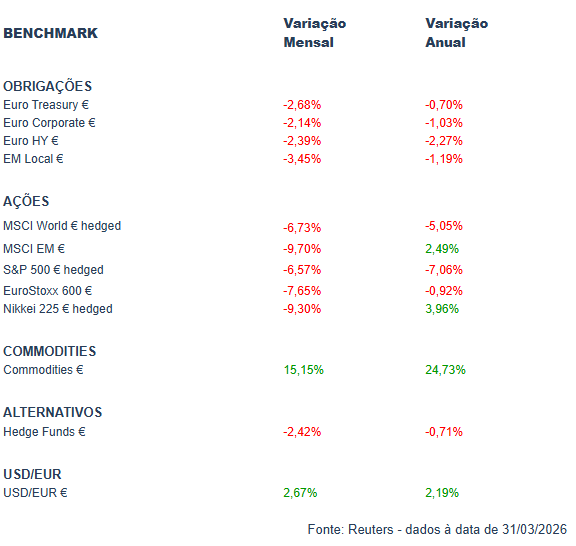
March was marked by geopolitical tensions in the Middle East, following the attack by US and Israeli armed forces on Iran. Amid an uncertain environment, episodes of volatility resurfaced, as investors sought to anticipate the duration and extent of the conflict’s impact on the global economy. Concerns over more persistent inflationary pressures overshadowed the debate on the number of rate cuts expected this year, driving a bear flattening move across major yield curves—with sharper increases in short-term rates compared to longer maturities. Beyond the instability in the Middle East, the month also brought episodes of distrust surrounding certain entities operating in the private credit market segments, contributing to a widening of corporate risk premiums, both in the investment grade and high yield segments, interrupting the spread compression trend seen in previous months. Emerging market debt was also dragged down by this risk-averse sentiment, as the specter of inflation resurfaced.
The impact of the military escalation in the Middle East on equity markets was significant and widespread. The S&P 500 approached correction territory relative to its January high, while the STOXX 600—which initially reacted more sharply to the war before partially recovering—posted one of its worst monthly performances since 2022. Japan and Emerging Markets were hit hardest. The critical variable remains the duration of the disruption in the Strait of Hormuz. Sectoral dispersion was notable. The Energy sector stood out with positive returns, benefiting from the risk premium embedded in oil and natural gas prices. The Technology sector, on the other hand, was the most penalized, pressured both by a defensive rotation and renewed concerns over the impact of Artificial Intelligence (AI) on business models whose value chains may be redefined. US markets showed greater relative resilience compared to Europe, with the latter suffering more due to its greater exposure to the energy shock. The market’s main concern is that the military escalation, and the associated energy disruption, could translate into a stagflationary shock, reducing visibility on the direction of monetary policy and anchoring expectations of higher rates for longer.
In commodities, it was a month of gains exceeding 15% in the raw materials index, with the war in the Middle East driving the main movements across its components, though not all in the same direction. Oil was among the biggest gainers, with the US benchmark rising more than 50%, given the severe constraints in the Strait of Hormuz that led to a sharp drop in global supply. Among industrial metals, copper posted some losses amid weaker economic sentiment, but aluminum rose to four-year highs, as a significant share of its production is based in the Middle East. US natural gas changed little, in contrast to European and Asian benchmarks, which surged in reaction to the constraints in Qatar. Gold lost more than 10%, pressured by the broad decline in financial assets and expectations of higher interest rates. Agricultural products rose, supported by fertilizer shortages and increased demand for biofuels.
In the foreign exchange market, the dollar strengthened in March due to increased risk aversion amid the war in the Middle East. The US currency was supported by capital flows seeking safe haven. The EUR/USD fell to $1.14 (its lowest level since August 2025). The pound gained ground against the euro until March 19. The British currency benefited from expectations of interest rate hikes by the Bank of England to combat inflation, reversing earlier expectations of imminent cuts. Subsequently, the pound underwent a downward correction as stagflation risks increased. The yen came under renewed pressure, now that other central banks may also raise interest rates this year, or at least refrain from cutting them. The USD/JPY traded above 160 yen at one point, prompting Japanese authorities to threaten currency intervention. The Brazilian real was volatile but found structural support as a net exporter of raw materials. The USD/BRL faced upward pressure due to risk-averse sentiment, which was offset by the country’s crude oil and grain export revenues.
Conclusion:
March was a month of adjustment and greater caution. Although markets avoided panic, the reality of higher energy prices and the possibility that interest rates may not fall as soon as expected changed the rules of the game. The resilience shown at the end of the month offers some encouragement, but vigilance over trade routes and production costs will remain a priority for the rest of the year.