

In managing high-net-worth portfolios, we find that the foundation of success in preserving and growing that wealth lies in behaviours that can be standardised: “History does not repeat itself, but it rhymes.” Mark Twain.
A holistic view of wealth, in which the business sphere, the sphere of real assets (including property, works of art, jewellery, and precious metals), and the sphere of financial assets are both influencers and influenced.
From behavioural patterns, we can establish some rules that may be useful in preserving wealth:
1. Capital Preservation
An investor should always operate on a capital-preservation basis. The risk profile should be used as a limit.
An investor with an aggressive profile should not, nor needs to, be invested at all times.
2. Risk must be assumed in advance
There is no return without taking risk. What matters is understanding the risk to which we are exposed, so that we can then assume it.
3. Cash is king
Maintaining liquidity in the portfolio should be regarded as an important asset to hold. Accept the cost of maintaining high levels of liquidity as a powerful tool.
4. Diversification should be pursued
In all its breadth—asset classes, geographic regions, issuers, financial intermediaries, to name only the main ones.
5. Be consistent.
The same rationale that leads to the investment decision in a position should also be used to define your exit.
6. Surf the wave
Once invested, let profits “run”, with the intention of benefiting from the trend.
7. Be pragmatic
At the time of investing, the objective is always to sell at a higher price than the purchase price.
8. Never increase a losing position without defining a stop loss in advance
When we intend to add to an asset which, despite its negative performance, we believe has recovery potential, we should set in advance a limit price at which we must exit the position if our scenario does not materialise.
9. Invest based on facts
Do not invest for personal reasons. Accumulated financial wealth has a history that
must be preserved.
10. Conflicts of interest
It is important to bear in mind that financial intermediaries may lose money when they extend credit, but inevitably this same balance becomes positive when they manage third-party assets.
11. In periods of low returns, fees, taxes, and dividends are highly relevant
Being demanding is important. With the current transparency required by MiFID II, it is important, when making decisions, to carefully analyse all associated costs: direct and indirect.
12. The market tends to revert to the mean in the long term
The law of supply and demand is a concept we should understand and accept.
13. Be as disciplined as possible
All major losses are associated with failing to comply with this rule.
14. Understand and accept human nature
The human factor leads to “infractions”, the main ones being:
- Overconfidence, which leads to a lack of discipline
- Inability to manage large amounts of information, which sometimes generates overconfidence
- In times of widespread declines, the need for “company”
- Anchoring that prevents objectivity
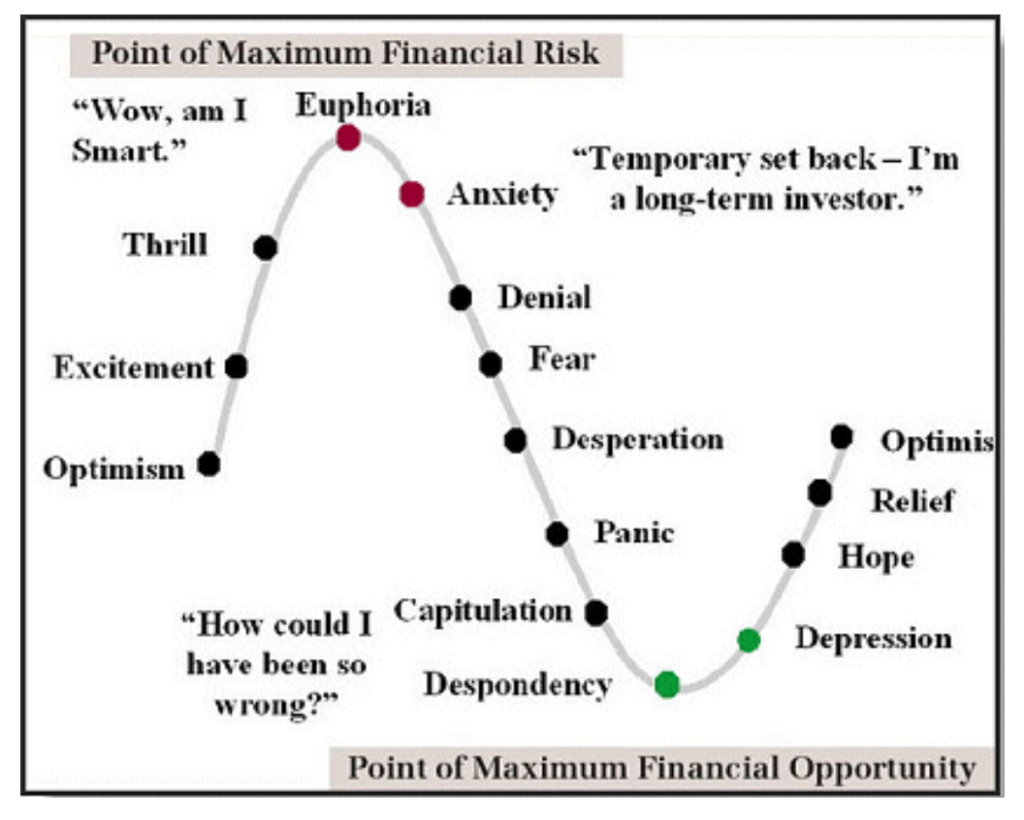
Source: The Kirk Report
The rules presented are not binding. Common sense should always prevail. The time horizon may mean that some rules are far more important than others.